
Project № 12
Delfi REW
Delfi Reservoir Engineering Workspace — five sprints of visual design updates for reservoir specialists.
This case study is gated. Enter the access key to view Schlumberger in full. Access persists for the rest of this session.
Delfi Reservoir Engineering Workspace — five sprints of visual design updates for reservoir specialists.
The Delfi Reservoir Engineering Workspace (REW) sits alongside FDPlan in Schlumberger's Delfi product family. Where FDPlan helps plan a field's development, REW is where reservoir engineers model, simulate, and analyse the reservoir itself — one of the most technically demanding interfaces in the entire E&P software landscape.
I contributed visual design updates across sprints 8 through 12, delivering iterative refinements aligned with the evolving Delfi Design Language System and the Storybook-driven pattern library I'd championed on the sister product.
FDPlan and REW share the Delfi platform but serve different specialists doing different work. The design question is the same question UBS Neo faces with nine tools: how do you make each product feel native to its domain while still feeling like part of one platform?
The answer is the Design Language System, pressed across both products with the same hand — same typography, same colour, same interaction primitives, same data-density rules.
The sprint-based cadence added a second constraint. Each of the 5 sprints had its own scope, its own blockers, and its own "must ship by Friday" pressure. Visual design had to keep pace with engineering without letting consistency slip.
First round of visual design updates across REW's core workspace surfaces — captured on screen and shared with the Abingdon, Houston and Minsk teams as the reference baseline.
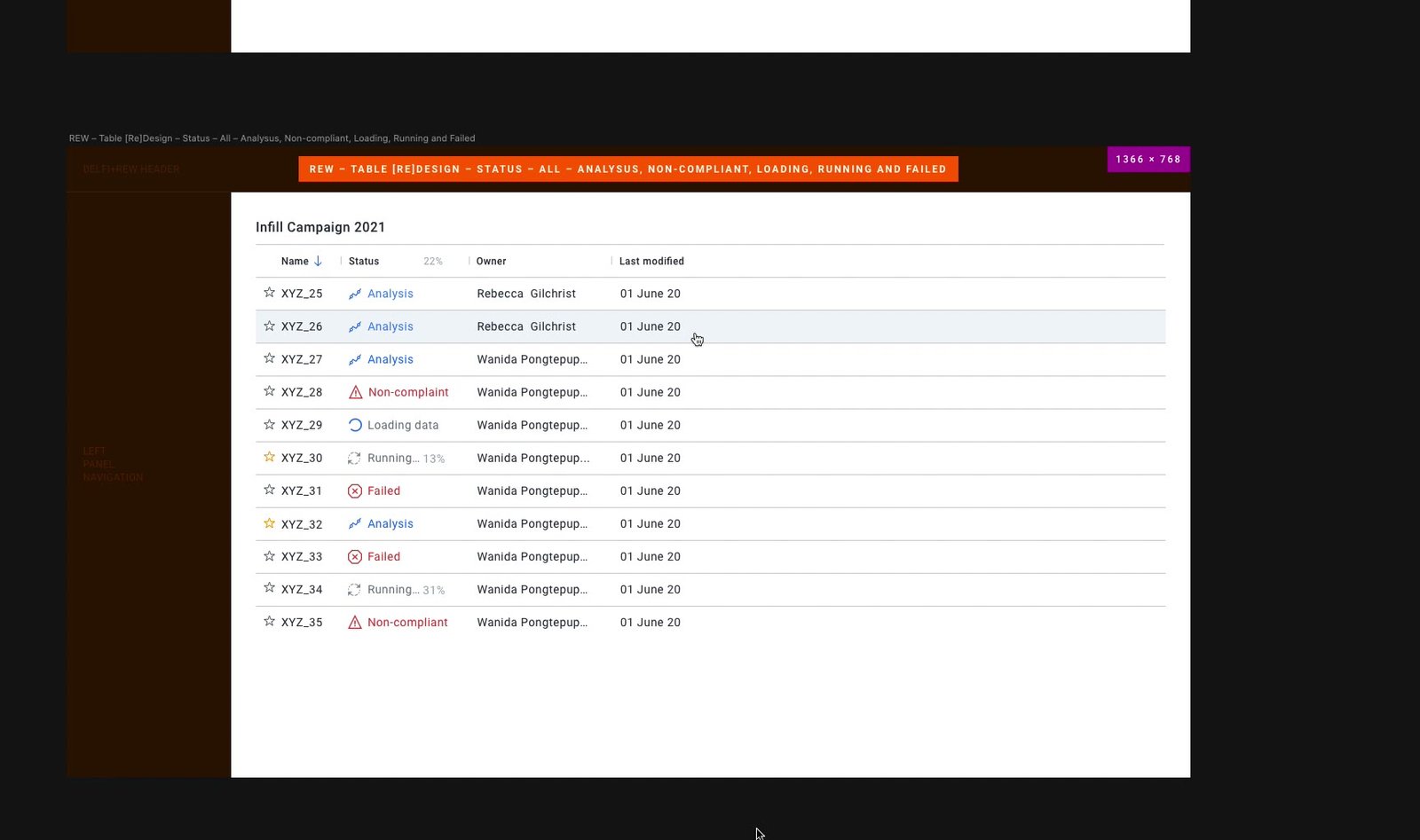
Refinements to data-dense panels, chart styling, and table density — the unglamorous work that makes a technical interface feel calm instead of cramped.
Pattern-library consolidation — every new component flowed through the Storybook-driven library so FDPlan and REW consumed the same primitives.
Final sprint delivered the last round of visual updates, closing the engagement with a handover cleanly aligned against the Delfi DLS.
Sister products share a DLS or they drift. There is no third option. — Delfi design principle
Representative stills from the Sprint 8–12 visual design walkthroughs — each sprint captured as a video, shown here as single frames.
Working on REW immediately after FDPlan made the design system case explicit: sister products share a DLS or they drift. Once a pattern slips in one product, the other product inherits it by accident, and the platform loses its shared voice. The Storybook-driven pattern library was the surface where that drift was actively prevented. That is the quiet, unglamorous value of a design system — and the reason it is worth the investment every time.